
Elderly Care Insurance vs LTC: Essential Family Guide
May 1, 2026
Elderly Care Insurance vs Long-Term Care Coverage Guide
Many adult children operate under the comforting but dangerous assumption that Medicare will cover their parents’ stay in an assisted living facility or prolonged home visits. The reality, as confirmed by standard government healthcare regulations, is often a shock: a $5,000-a-month bill that arrives just as a family is dealing with a health crisis. This common misunderstanding stems from confusing medical treatment, which insurance covers, with “custodial care,” which typically falls on the family to fund. This guide on “Elderly Care Insurance vs Long-Term Care Coverage: What Families Should Know” clarifies these distinctions for families evaluating insurance for seniors.
Consider a scenario where a loved one suffers a fall and requires help with basic tasks like bathing, dressing, or eating for six months while they recover. While standard health insurance acts as a fire extinguisher for the immediate medical emergency, it rarely covers this type of daily living assistance once a doctor deems the patient stable. Industry data reveals that this coverage gap is the leading cause of unexpected asset depletion for retirees.
Navigating this landscape requires defining “elderly care” as the broad category of support services, and “long-term care coverage” as the specific financial engine designed to pay for them. Financial planning for elderly care costs is the most effective way to protect your family’s savings while ensuring your parents receive the quality support they deserve, and it should include an early review of senior care options.
The ‘What’ vs. The ‘How’: Distinguishing Elderly Care Services from LTC Insurance
When families discuss caring for aging parents, terms often get muddled. “Elderly care” isn’t a policy you buy; it is the broad category of services required when daily tasks become difficult. Think of this as the “What”—the tangible help provided by home aides, adult day care centers, or skilled nursing facilities that keeps a senior safe and comfortable.
Consider a simple household analogy to see where insurance fits. If the care itself is the contractor repairing your home, the insurance is simply the dedicated bank account used to pay them. Elderly care insurance operates as the funding vehicle that makes these services accessible without wrecking your retirement plan. Without this specific coverage, or perhaps extended care insurance riders on life policies, families are left relying on private pay senior care options, which can rapidly deplete lifelong savings.
Separating the service from the payment method clarifies your actual planning needs:
- The What (Service): Hands-on assistance with bathing, meal preparation, mobility support, and safety supervision.
- The How (Funding): A policy designed to reimburse costs, daily benefit caps, and inflation riders that protect purchasing power.
With the service and funding separated, you must confront the reality that standard medical insurance rarely crosses this line.
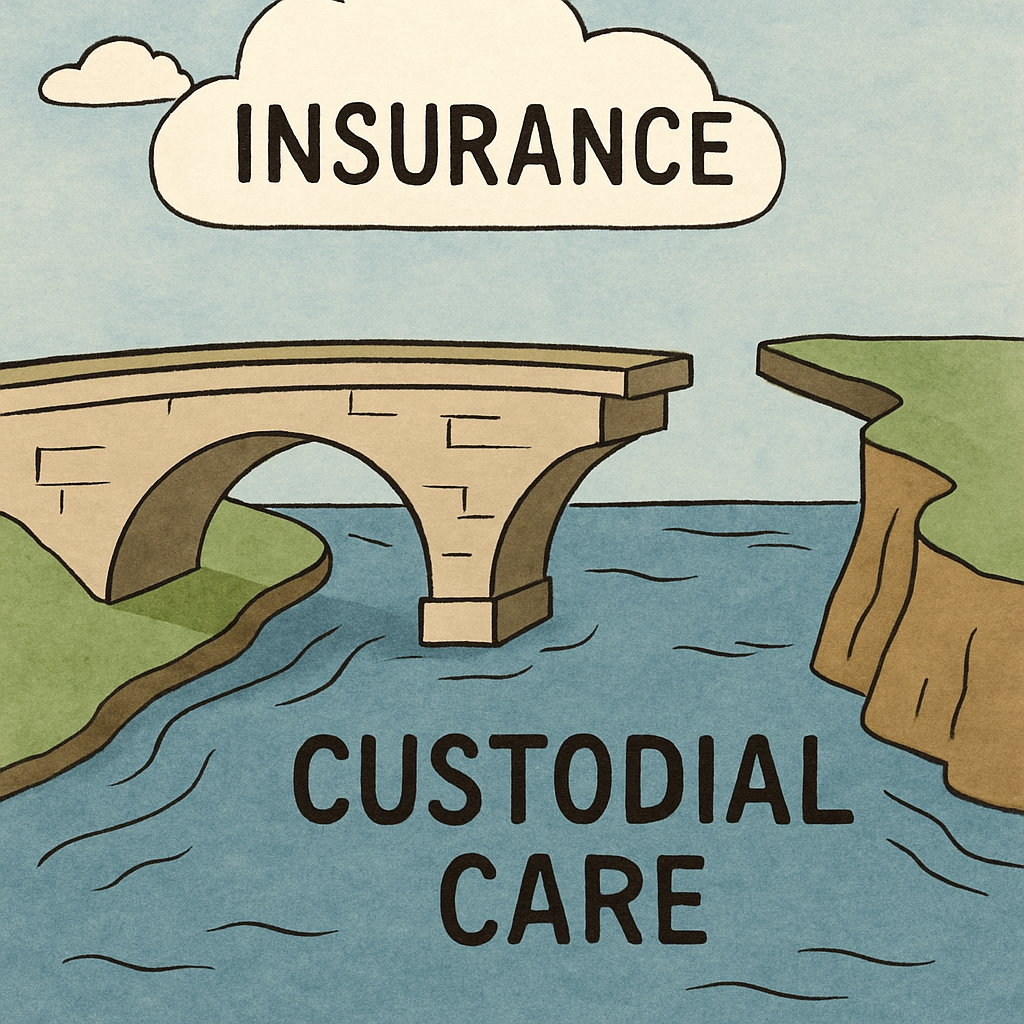
The $100,000 Misconception: Why Medicare and Health Insurance Stop Where Your Care Begins
If you assume your existing health plan handles extended senior needs, you are falling for the most expensive misunderstanding in American healthcare. Standard policies and Medicare are essentially “cure” insurance designed to fix broken bones or treat sudden illnesses, not “care” insurance for ongoing support. This distinction creates a massive funding void because Medicare does not pay for long-term care in a chronic scenario. Generally, the answer is a stark no.
The dividing line lies between medical necessity and functional assistance. Health insurance pays for skilled nursing care, which requires a licensed professional to administer injections or physical therapy to improve a condition. Once a patient stops improving and simply needs help maintaining their quality of life, the service is reclassified as custodial care. Since this type of help involves non-medical tasks like bathing or eating, insurers view it as a personal cost rather than a medical one, leaving families to pay the bill.
Providers look at Activities of Daily Living eligibility for insurance to determine when coverage ends, and out-of-pocket spending begins. If your parent is healthy enough to leave the hospital but cannot safely dress, eat, or move around the house without assistance, they have triggered a need that traditional health plans strictly exclude. The system is built to pay for the surgery that repairs a hip, but not the aide who helps the patient walk to the kitchen three months later.
Even within the limited custodial care vs skilled nursing care window that Medicare does cover, the safety net is incredibly short. Benefits typically cover the first 20 days fully, with partial coverage extending only up to day 100, and only if improvement is documented. After that 100-day cliff, or sooner if progress stalls, the financial responsibility shifts entirely to the family, making it crucial to understand the real-world costs of this care.
Budgeting for Reality: Mapping the $4,500+ Average Monthly Cost of Home Care
Once the financial responsibility shifts from Medicare to your family, the numbers can be startling. Many people assume staying in their own house is the cheap option, but when you analyze home health care vs assisted living costs, the price tags are often comparable, depending on the level of help required. Current industry data paints a sober picture of the monthly expenses families must cover:
- Home Health Aide: ~$6,292 (based on 44 hours/week)
- Assisted Living Facility: ~$5,350 (national median)
- Private Room Nursing Home: ~$9,733
Most policies do not begin paying these bills immediately, even after a doctor certifies the need for care. This delay is known as the elimination period in long-term care insurance, which functions exactly like a “time deductible.” Just as you pay the first $500 of a car repair, you must pay for the first 30, 60, or 90 days of care entirely out of pocket before the insurance company contributes a dime.
This “financial runway” is essential for protecting your savings. If the average cost of home health care per month exceeds $6,000, a standard 90-day elimination period requires you to have roughly $18,000 in liquid cash ready before your benefits start. Knowing exactly how much risk you can afford to self-insure is the first step in choosing between a traditional standalone policy and modern hybrid alternatives.
Traditional LTC or Hybrid Life Insurance? Picking the Right Financial Shield
The biggest hesitation families face when buying coverage is often the “use it or lose it” risk. With traditional standalone policies, you pay premiums annually, but if you never require care, those payments disappear—much like car insurance without an accident. This model typically offers the highest coverage amount for the lowest monthly cost, but the fear of “wasted” money has pushed the market toward more flexible solutions.
Modern financial planning often favors asset-based plans to solve this inefficiency. When weighing hybrid life insurance vs traditional long-term care, the hybrid model functions as a multi-purpose tool: the policy pays for care if you get sick, or provides a death benefit to your heirs if you stay healthy. While hybrid plans usually require a larger upfront investment—often a single lump sum or condensed payment schedule—they guarantee that the premiums paid will eventually return to your family in some form.
Choosing between these two “financial shields” requires balancing current cash flow against future asset protection:
- Traditional Policy: Lower initial annual cost, potential for future rate hikes, generally offers the most “bang for your buck” on pure care benefits, but zero return if unused.
- Hybrid Policy: Higher upfront cost, premiums are guaranteed never to increase, and it creates a safety net for heirs through a life insurance component.
Regardless of the structure you choose, the purchasing power of your benefits must keep pace with rising healthcare costs. Adding inflation protection for long-term care policies —typically a 3% to 5% compound annual increase—ensures your daily benefit retains its real value twenty years from now. You should also consult a CPA about the tax advantages of long-term care premiums, as the IRS allows you to deduct eligible traditional premiums as medical expenses up to certain age-based limits. For those unable to qualify for private insurance due to health or budget constraints, the focus must shift to preserving assets against government recovery systems.
Saving the Family Home: Navigating Medicaid Spend-Down and State Partnership Programs
For families relying on government safety nets, the path to eligibility often requires exhausting nearly all savings first, due to strict Medicaid spend-down rules for nursing homes. Many assume they can simply gift assets to children right before needing care, but the government conducts a rigorous review of your financial history to prevent this.
3 Key Rules for the Medicaid ‘Look-Back’ Period:
- The 5-Year Window: Medicaid reviews all financial transfers made in the 60 months before your application.
- The Penalty: Assets given away or sold below market value during this window delay your coverage eligibility.
- Exemptions: Spousal transfers and legitimate spending on care usually do not trigger penalties.

Fortunately, you can protect your legacy without hiding assets by utilizing long-term care partnership programs by the state. These initiatives incentivize buying private insurance by offering “dollar-for-dollar” asset protection; for every dollar your private policy pays out in benefits, Medicaid allows you to keep a dollar of your own assets above the usual poverty-level limits if you eventually need government aid.
Coverage gaps can also be managed by understanding short-term care insurance vs long-term care. While long-term policies are designed for years of chronic support, short-term plans typically cover one year or less and have simpler medical underwriting, making them a viable “bridge” for those who cannot qualify for broader coverage.
Your Family Security Checklist: 3 Steps to Finalize Your Care Plan Today
You no longer have to rely on the assumption that generic health insurance will cover every need. By distinguishing the service of elderly care from the specific protection of Long-Term Care coverage, you now possess the clarity to protect your family’s assets. While “elderly care” defines the necessary daily support, securing the right coverage ensures that financial planning for elderly care costs results in options rather than forced compromises. This knowledge transforms you from a passive observer to an empowered advocate for your family’s future.
Turn this awareness into a protective strategy with three immediate steps:
- Run a Coverage Audit: Review existing policies to confirm exactly what is excluded so there are no financial surprises during a crisis.
- Have the ‘ADL’ Discussion: Use activities of daily living to ask parents about their preferences, focusing specifically on where they want to receive care.
- Schedule an Advisor Meeting: Consult a professional to understand how to qualify for long-term care benefits and explore funding options if traditional policies aren’t a fit.
Ultimately, proactive planning offers something more valuable than just reimbursement checks: it offers dignity. When you remove the panic of funding from the equation, you gain the freedom to focus entirely on being a supportive family member rather than a stressed account manager. The true return on investment here is the peace of mind that comes from knowing you have the resources to choose the best path forward.
Not sure which type of coverage makes the most sense for your family and budget?
Schedule a free, no-obligation consultation, and we’ll help you compare elderly care insurance vs. long-term care coverage, understand benefit triggers and costs, and map out practical next steps based on your goals.