
Life Annuity vs. Other Retirement Options: Key Trade-Offs
April 29, 2026
Life Annuity vs Other Retirement Income Options
Imagine waking up on the first of every month knowing a deposit has hit your bank account, regardless of whether the stock market soared or stumbled yesterday. This is the “paycheck promise” that makes a life annuity appealing to many, offering a sense of security similar to Social Security. Yet, that guaranteed income comes with a distinct price tag: the loss of access to your lump sum of cash.
That raises the core question—Life Annuity vs Other Retirement Income Options: What’s the Trade-Off?—and how this choice fits into your retirement planning and broader retirement income strategies.
For nearly forty years, your primary goal has likely been filling a “bucket”—accumulating as much wealth as possible in your 401(k) or IRA. However, behavioral finance experts suggest that the psychological shift from saving to spending is often the most stressful part of retirement planning. You are no longer trying to hit a high score on an account balance; you are trying to ensure that balance translates into reliable purchasing power for the rest of your life.
Consider the Joneses, a hypothetical couple retiring at 65 with a $500,000 nest egg. They possess wealth, but they do not yet have income. Their objective is to create a retirement income floor strategy—a baseline of cash flow that covers essential needs—without running out of money if they live well into their 90s. The difference between having a pile of money and having a stream of income is the defining battle of modern retirement.
While a life annuity functions as a personal pension to solve this problem, it is not the only path available among your retirement income options. Choosing the right strategy requires you to weigh the safety of a guarantee against the flexibility of keeping your cash, all while confronting three specific fears:
- Longevity Risk: The mathematical danger of living longer than your savings last.
- Sequence of Returns Risk: The threat of a market crash occurring right when you begin taking withdrawals.
- Inflationary Erosion: The slow loss of purchasing power as the cost of living rises over time.
The Life Annuity Decoded: Why It’s Your Personal Pension
For decades, you have likely focused on filling your retirement bucket, but climbing down the mountain requires a completely different skillset than climbing up. This is where the Single Premium Immediate Annuity (SPIA) enters the picture, acting essentially as a personal pension you buy for yourself. By handing over a lump sum to an insurance company—a process formally known as annuitization—you transform a static pile of cash into a steady, guaranteed monthly deposit that lands in your bank account for as long as you breathe, functioning much like a second Social Security check.
Insurance companies can make these lifelong promises through a mechanism called risk pooling, which operates on the simple reality that nobody knows exactly how long they will live. In a large group of retirees, funds from those who pass away earlier help support those who live well into their nineties, ensuring that the “super-agers” never outlive their income. This creates a financial safety net that a standard savings account simply cannot match, as your personal savings have no way of replenishing themselves if you happen to live ten years longer than you predicted.
This security comes with a strict price tag, however, primarily in the form of lost flexibility and control. Once you sign that contract to secure your income floor, your original lump sum is generally gone, meaning you cannot access it for emergencies or leave the full pile to heirs if you pass away unexpectedly early. While this lack of liquidity makes the annuity a powerful tool for covering essential bills, many retirees hesitate to lock away their nest egg, leading them to ask how this guaranteed approach compares to managing their own investments using the 4% rule.
Systematic Withdrawals vs. Payout Rates: Can the 4% Rule Keep Up?
Managing your own portfolio relies on the popular “4% Rule,” one of several retirement income options developed to help your money last for thirty years. The concept is straightforward: you keep your nest egg, invest it in a mix of stocks and bonds, and withdraw 4% in the first year—for example, $20,000 from a $500,000 portfolio—adjusting subsequent withdrawals for inflation. This approach maintains total control over your assets, allowing you to access cash for sudden health costs or leave an inheritance, but it shifts the burden of survival entirely onto your shoulders.
When comparing the two options, you might notice that an annuity often quotes a “payout rate” of 6% or 7%, while financial planners recommend withdrawing only 4% from your own investments. It is crucial to distinguish between an investment return and a payout rate. The annuity pays a higher percentage because the insurance company is returning your original principal to you bit by bit, combined with interest, whereas the 4% rule generally aims to keep your principal intact for a longer period.
Reliance on the stock market also introduces a specific danger known as sequence risk—the chance of a market crash right when you stop working. If your portfolio drops 20% the year you retire, continuing to withdraw the same monthly amount forces you to sell more shares at a loss, which can deplete your savings years too early. An annuity, by contrast, ignores the stock ticker completely; your check arrives even if the market falls.
To choose the right path among retirement income strategies, consider the fundamental trade-offs between these two approaches:
- Flexibility: High for the 4% Rule; Non-existent for Annuities.
- Guarantees: None for the 4% Rule; 100% for Annuities.
- Market Exposure: You feel every bump with the 4% Rule; Annuities insulate you.
- Growth: The 4% Rule captures market upsides; Annuities generally provide a fixed income.
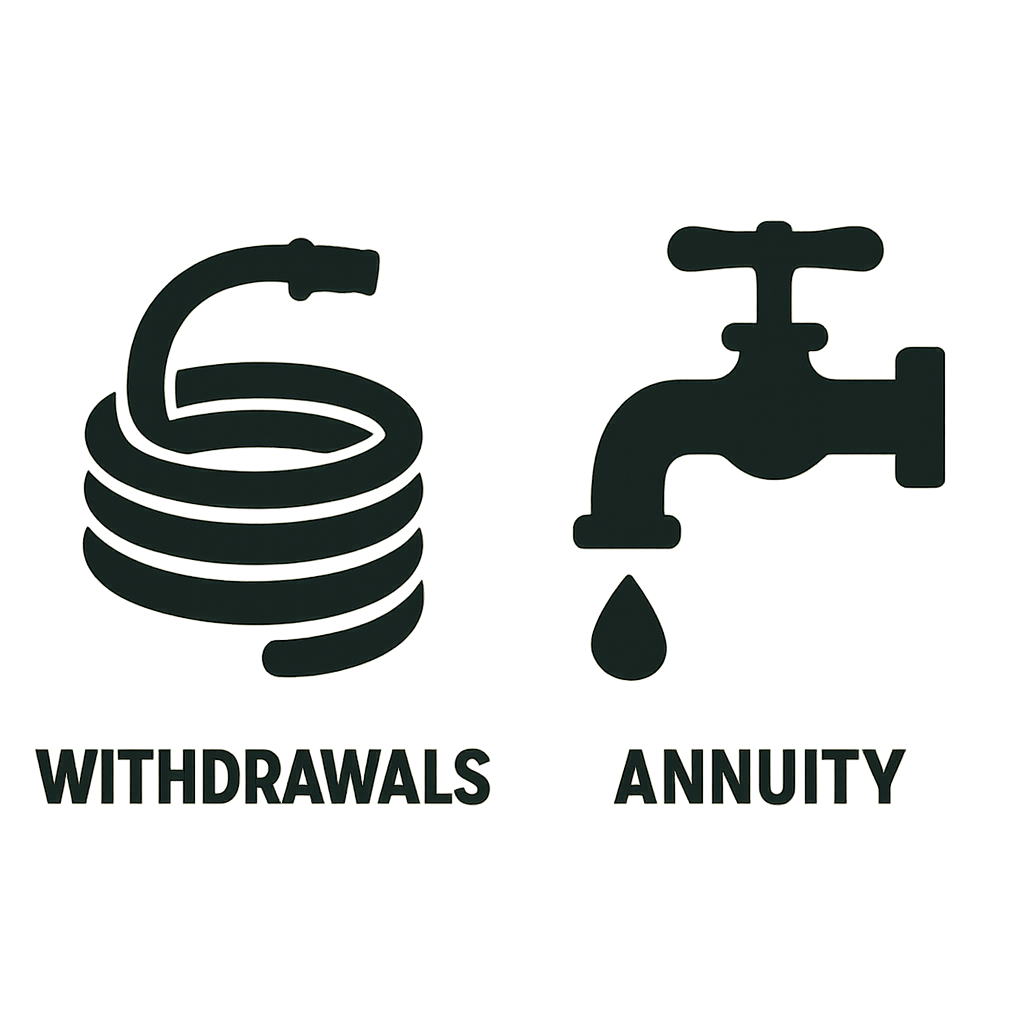
Control vs. Certainty: The $500,000 Trade-Off
Writing a check for $500,000 to an insurance company is arguably the most difficult psychological hurdle in retirement planning. You have spent forty years building that nest egg, and handing over the keys feels counterintuitive to the goal of accumulating wealth. In exchange for this transfer, you receive a life annuity—a promise of income that never expires—but you usually lose access to the lump sum itself. This is the liquidity trade-off: you are purchasing safety, but the cost is the inability to ask for your money back if you change your mind or want to buy a vacation home on a whim.
Viewing this transaction through the lens of investment returns often leads to hesitation because the math emphasizes safety over high growth. Instead, consider the purchase as you would homeowner’s insurance; you pay a premium to protect against a catastrophic event. In this case, the catastrophe isn’t a fire, but the risk of outliving your savings. When asking if a life annuity is worth the loss of liquidity, the answer depends on your baseline needs. A sound retirement income floor strategy suggests using an annuity only to cover your essential bills—electricity, groceries, and taxes—while keeping the rest of your portfolio liquid for emergencies and lifestyle goals.
The true return on investment here is largely emotional, measured in the removal of anxiety rather than percentage points. When the stock market dips, the retiree relying solely on withdrawals worries about reducing their spending, whereas the annuitant knows their check will clear regardless of economic turbulence. This certainty becomes increasingly valuable the longer you live. While giving up control is difficult, it prepares you for the ultimate financial challenge: ensuring your income survives even if you reach a centenarian age.
Beating Longevity Risk: How Annuities Win the Living to 100 Race
The biggest unknown variable in your financial plan isn’t the stock market; it is your lifespan. If you rely solely on a standard savings account, you are forced to guess exactly how long you will live so you can ration your money correctly. Guessing too short means you could run dry at age 85 while still in good health, a scenario known as longevity risk. This is where the life annuity distinguishes itself as a highly effective retirement income strategy for risk-averse investors. It acts as insurance against a long life, shifting the danger of depleting your funds from your shoulders to the insurance company.
You might wonder how an insurer can promise to pay you forever, even if you live to 105. The answer lies in a concept often called the “pooling bonus.” The insurance company gathers the premiums of thousands of retirees into a single pool. Statistically, some members of the group will pass away earlier than expected, leaving funds behind that effectively subsidize the payments for those who live longer. Unlike a personal bank account, where the money is strictly yours and gone once withdrawn, this pooled approach ensures that survivors always have a source of funding.
Mathematically, living a long life turns an annuity into a powerful financial tool. Every check received after you have “earned back” your original premium is essentially profit funded by the pool. This structure allows you to mitigate longevity risk in retirement by capitalizing on three distinct advantages:
- Zero Depletion Risk: Payments continue even after your original investment amount is mathematically exhausted.
- The “Longevity Bonus”: The effective return on your investment increases every year you remain alive.
- Spendable Confidence: You can spend the monthly income freely without the need to hoard cash for age 95.
However, while a guaranteed check protects you from running out of money, it faces a different enemy: rising prices. Applying the “Grocery Store Test” reveals if your fixed income can keep up with the cost of bread.
The Grocery Store Test: Protecting Your Monthly Check From Inflation
Imagine walking into your local supermarket twenty years from now. While your fixed annuity check still deposits the same $2,000 it does today, the price of milk and bread has likely doubled. This is the “silent thief” of retirement planning: inflation. A standard fixed annuity offers excellent security against stock market crashes, but it often fails to account for the rising cost of living. Over a 25-year retirement, even a modest 3% annual inflation rate will effectively cut your purchasing power in half, meaning you would need $4,000 in the future just to buy what $2,000 buys today.
Fighting this erosion requires a proactive strategy rather than passive hope. You cannot simply rely on a flat paycheck to cover three decades of economic changes. To ensure your lifestyle remains sustainable, consider these three specific methods for adding inflation protection for retirement income streams:
- Add a COLA Rider: You can purchase a Cost of Living Adjustment (COLA) that automatically increases your payments annually. The trade-off is a lower starting check—often 20% to 30% less initially—but your income grows over time to match rising prices.
- Practice Annuity Laddering: Instead of converting your entire nest egg at once, buy smaller annuities every five years. Older ages generally command higher payout rates, and this strategy allows you to potentially capture higher interest rates in the future.
- Pair with Equities: Retain a portion of your portfolio in dividend growth stocks or mutual funds. While the annuity covers your essential bills, the stock market’s long-term growth potential provides the extra cash flow needed to offset inflation.
Balancing these tools allows you to build a floor of safety that rises along with your expenses. However, locking away too much capital to secure these guarantees creates a new problem: a lack of access to cash for emergencies. We must next examine the trade-off between a guaranteed paycheck and the flexibility to handle life’s surprises.
Liquidity and Legacy: What Happens to the Money if You Die Early?
One of the most persistent fears retirees face when considering an annuity among their retirement income options is the scenario where they hand over their life savings, only to pass away shortly after. This is often called the “bus test,” and in a standard “Life Only” contract, the insurance company indeed keeps the remaining principal to pay other people who live longer. While this option provides the highest monthly paycheck because you are taking the maximum risk, it leaves nothing for your family, creating a stark trade-off between maximizing your current income and preserving a financial legacy.

For married couples, leaving a surviving spouse without income is rarely an acceptable risk, making the joint and survivor life annuity vs lump sum decision critical. By selecting a Joint and Survivor option, the payments continue as long as either you or your partner is alive, ensuring that a widow or widower isn’t left destitute. This peace of mind comes with a specific cost: the insurance company will reduce the monthly payment amount compared to a single-life policy, but it effectively transfers the longevity risk away from both partners for the duration of their lives.
Even if you are single or your spouse is protected, you might still worry about the insurance company “winning” if you die early. To counter this, many plans offer “Period Certain” or “Cash Refund” features, which guarantee that payments will flow to a beneficiary for a set time, such as 10 or 20 years, or until the total payout equals your original investment. These survivor benefit options ensure that your hard-earned capital stays in the family rather than disappearing into the insurer’s pool, though adding these guarantees will further reduce the size of your monthly check.
Deciding if a life annuity is worth the loss of liquidity ultimately depends on whether you value maximizing your monthly budget or ensuring a specific inheritance amount. Once you have determined how the money flows to you and your heirs, you must tackle the government’s claim on those funds. We need to look closely at how the IRS treats these payments compared to your other retirement accounts.
Tax Puzzles: Comparing Annuity Payments to IRA Distributions
Most retirees fund their income strategies using pre-tax dollars rolled over from a 401(k) or traditional IRA. In industry terms, these are “Qualified” funds, meaning the money has never been taxed. When you use this capital to buy an annuity, the IRS treats every monthly check exactly like a standard withdrawal: 100% of the income is taxed at your ordinary income rate. Additionally, holding an annuity inside an IRA does not exempt you from Required Minimum Distributions (RMDs); once you reach age 73, you must ensure your payouts are large enough to satisfy the government’s mandatory withdrawal rules.
The equation shifts dramatically if you purchase an annuity using personal savings from a bank account or brokerage fund—money on which you have already paid income tax. These “Non-Qualified” funds benefit from a specific calculation known as the “Exclusion Ratio.” Because the IRS cannot tax the same dollar twice, a large portion of every check you receive is classified as a tax-free return of your original principal. Only the portion representing interest earnings is taxable, which can significantly lower your effective tax rate compared to other fully taxable investments. This difference can influence how you prioritize your retirement income strategies.
Understanding the source of your funds is crucial for accurate retirement planning. Here is how the tax treatment of annuity payments generally breaks down compared to IRA distributions:
- Qualified (Pre-Tax 401k/IRA): 100% of the income payment is taxable; RMD rules apply.
- Non-Qualified (After-Tax Savings): Only the growth portion is taxable (Exclusion Ratio applies); generally, no RMDs unless inherited.
Having clarified how much of your money you get to keep after taxes, the next challenge is the external threat that can derail plans even before they begin: the risk of a market crash right as you hand in your notice.
The Red Zone Warning: Managing Market Volatility During Your First Five Years of Retirement
Timing is often just as important as talent in the financial world, especially when you cross the threshold into retirement. Most investors understand that markets naturally fluctuate, but a significant downturn occurring immediately after you stop working can devastate a portfolio in a way that a mid-career crash never could. Financial planners refer to the five years before and after retirement as the “Red Zone,” where you are most vulnerable to the sequencing of returns risk. This concept simply refers to the danger of bad market “luck” striking exactly when you switch from saving money to spending it.
Why is this timing so critical compared to other market dips? When you rely entirely on a fluctuating investment account for your monthly bills, a market correction forces you into the dangerous position of being a “forced seller.” You have to sell shares to pay for groceries and utilities, regardless of the current share price. Selling assets when their value is down locks in those losses permanently, leaving you with fewer shares to benefit from the eventual recovery. By managing market volatility with guaranteed income, you effectively remove the pressure to liquidate your growth investments at the worst possible moment.
Annuities function as a strategic buffer against this specific risk by providing a baseline of cash flow that arrives regardless of Wall Street’s performance. If your essential expenses are covered by a guaranteed paycheck, you have the luxury of waiting for the market to bounce back before tapping into your investment accounts again. This approach transforms the annuity from a simple insurance product into a volatility shield for your broader wealth. Implementing a retirement income floor strategy allows you to calculate exactly how much guaranteed income is necessary to secure your lifestyle, setting the stage for a portfolio that balances safety with growth potential.
The Income Floor Strategy: Building a Hybrid Portfolio for Best-of-Both-Worlds Results
Most retirees strive for a “sleep well at night” portfolio, but they often struggle to balance the safety of cash with the growth potential of stocks. The solution lies in building an “Income Floor.” This concept distinguishes between essential survival expenses—housing, food, utilities, and healthcare—and discretionary lifestyle spending. By ensuring your “must-haves” are covered by guaranteed sources before you even get out of bed, you isolate your standard of living from the unpredictability of the stock market.
Constructing this floor requires a clear look at your monthly budget rather than complex investment theories. A practical retirement income floor strategy recommends a simple four-step process to identify your specific needs:
- Total your essential monthly bills (mortgage, groceries, utilities, insurance).
- Sum your existing guaranteed income sources (Social Security and pensions).
- Subtract your guaranteed income from your essential expenses to find the “Gap.”
- Purchase a simple income annuity specifically designed to fill that gap.
Once you identify the size of your gap, you can determine exactly how much of your portfolio should be in annuities. For many households, this translates to roughly 25% to 40% of their total nest egg, though the exact figure depends entirely on the cost of your essentials. The goal is not to annuitize every dollar you own, which would lock up your liquidity, but to purchase just enough insurance to satisfy your baseline requirements while keeping the rest of your money accessible.
This hybrid approach creates the best retirement income strategy for risk-averse investors who still need their savings to grow over time. When you know your electric bill is paid no matter what the economy does, you gain the emotional fortitude to keep the remainder of your portfolio invested in the market to combat inflation. With your safety net secured, you are ready to move from theory to practice.
Your Three-Step Action Plan: Choosing the Right Income Path for Your Lifestyle
You started this journey viewing your savings as a static number, but you now see it as a tool to generate a reliable income. The anxiety of “will it last?” is replaced by the clarity of knowing exactly what you are trading: you give up some liquidity today to guarantee security for tomorrow. This understanding allows you to move past the paralysis of analysis and make a choice based on your personal comfort zone rather than market speculation.
To finalize whether a life annuity belongs in your portfolio, ask yourself three honest questions:
- Is my “income floor” too low? If Social Security and pensions do not cover your essential bills (housing, food, healthcare), you likely need more guaranteed income.
- Do I value safety over flexibility? If the thought of managing investments during a recession keeps you awake at night, you may prefer the “hands-off” nature of an annuity.
- Is leaving a large inheritance secondary? If you are comfortable spending down your assets to maximize your own lifestyle rather than preserving a large lump sum for heirs, this path aligns with your goals.
If you answered “Yes” to these, your next steps are clear. First, audit your monthly expenses to calculate the exact gap between your needs and your current guaranteed income. Second, verify your Social Security benefits to confirm your baseline. Finally, shop for the best retirement income strategy by comparing payout rates from highly-rated insurance companies and other retirement income options. Treat this process like shopping for a mortgage; rates vary significantly, and finding the right carrier can increase your monthly “paycheck” substantially.
Ultimately, the decision to buy an annuity is not just about math; it is about how you want to experience your retirement. You are trading the potential for a larger financial legacy for the reality of immediate peace of mind. By securing your basic needs with a guaranteed stream of income, you gain the freedom to enjoy the rest of your savings without the constant fear of running out.
Want to know which retirement income option fits your timeline and risk comfort best?
Schedule a free, no-obligation consultation, and we’ll help you compare a life annuity to other income approaches (like systematic withdrawals and Social Security timing) so you can build a plan for reliable income, without guessing.