
Inherited IRA Rules 2026: 10-Year Rule, Annual RMDs, and Beneficiary Options
September 15, 2026
Understanding the 10-Year Deadline and Annual RMDs
A beneficiary-focused guide to categories, deadlines, annual distribution rules, tax treatment, and records that can prevent expensive errors

Featured illustration: An inherited IRA combines beneficiary status, account records, and a final distribution deadline.
Inheriting an IRA creates a set of tax deadlines at the same time a family may be managing a loss. The most common shortcut—’wait ten years, then withdraw everything’—is correct for some beneficiaries and wrong for others.
For many adult non-spouse beneficiaries, the inherited account must be emptied by December 31 of the tenth year after the owner’s death. But annual required minimum distributions, or RMDs, may also be required when the owner died on or after the owner’s required beginning date. [1,2]
Key takeaways
- Most designated beneficiaries who are not eligible designated beneficiaries must empty the account by the end of year ten. [1]
- If the owner died before the required beginning date and the 10-year rule applies, no distribution is generally required in years one through nine. [1]
- If the owner died on or after the required beginning date, annual beneficiary RMDs generally continue and a non-eligible designated beneficiary must still empty the account by year ten. [1,3]
- Surviving spouses, eligible designated beneficiaries, non-designated beneficiaries, qualified trusts, and pre-2020 inheritances can follow different rules. [1,2]
- A missed RMD can trigger a 25% excise tax, potentially reduced to 10% after a timely correction; reasonable-cause waiver procedures may also apply. [5]
- The 10% early-distribution tax generally does not apply to a beneficiary distribution after death, but ordinary income tax can still apply. [1]
| Accuracy and date scope: This article focuses on IRAs whose owners died after 2019 and applies final Treasury RMD regulations effective for distribution years beginning in 2025. Pre-2020 deaths, certain trusts, annuity contracts, multiple-beneficiary arrangements, employer plans, and successor beneficiaries may require a different analysis. [1,3] |
Step 1: identify the beneficiary category
The beneficiary label determines which distribution methods are available. Start with the legal beneficiary designation and the status of that beneficiary—not simply the family relationship. [1,2]
| Beneficiary category | Typical examples | Core rule to investigate |
|---|---|---|
| Surviving spouse (sole beneficiary) | Husband, wife, or qualifying spouse | May keep the account inherited or elect to treat it as the spouse’s own; timing choices depend on both spouses’ ages and the owner’s RBD. |
| Other eligible designated beneficiary (EDB) | Owner’s minor child; disabled or chronically ill person; person not more than 10 years younger | Life-expectancy payments are generally available; a 10-year tail can begin after the EDB dies or a minor child reaches majority. |
| Other designated beneficiary | Most adult children, grandchildren, siblings, friends | 10-year deadline generally applies; annual RMD question depends on whether owner died before or after RBD. |
| No designated beneficiary | Estate, charity, or some nonqualifying trusts | Five-year rule if owner died before RBD; owner’s remaining life expectancy generally if death was on/after RBD. |
Table note: A trust named on the account is not automatically treated as a designated beneficiary. Special look-through and applicable multi-beneficiary trust rules can change the result. [1]
A minor child receives EDB treatment only when the child is the deceased account owner’s child. When that child reaches majority under the federal rule, a 10-year period generally begins for the remaining balance. [1]
Step 2: determine whether the owner died before or after the required beginning date
The required beginning date, or RBD, is the date by which the original owner was required to begin lifetime RMDs. Do not infer it from age alone: Congress changed the starting ages, and a person who was the same age at death can be before or after the RBD depending on birth year and prior law. [1,4]
| Owner / beneficiary situation | Annual distributions after death | Outside deadline |
|---|---|---|
| Owner before RBD; non-EDB designated beneficiary | No annual RMD required in years 1–9 under the 10-year rule; voluntary withdrawals are allowed. | Balance must be zero by Dec. 31 of year 10. |
| Owner on/after RBD; non-EDB designated beneficiary | Annual beneficiary RMDs generally apply using the final-regulation method. | Balance must also be zero by Dec. 31 of year 10. |
| Owner before RBD; nonspouse EDB | Life-expectancy payments generally apply; a 10-year election may be available under applicable terms. | Depends on method; later 10-year tail may apply. |
| Owner on/after RBD; nonspouse EDB | Life-expectancy payments generally continue. | A later 10-year tail generally begins after EDB’s death. |
| No designated beneficiary; owner before RBD | No fixed annual pattern under the five-year rule. | Balance generally zero by Dec. 31 of year 5. |
| No designated beneficiary; owner on/after RBD | Owner’s remaining life expectancy generally controls. | No automatic 10-year deadline under this category. |
Table note: This matrix is a federal-rule orientation, not a substitute for the governing IRA or plan document. RBD and life-expectancy computations should be confirmed for the actual decedent and beneficiary. [1,2,3]
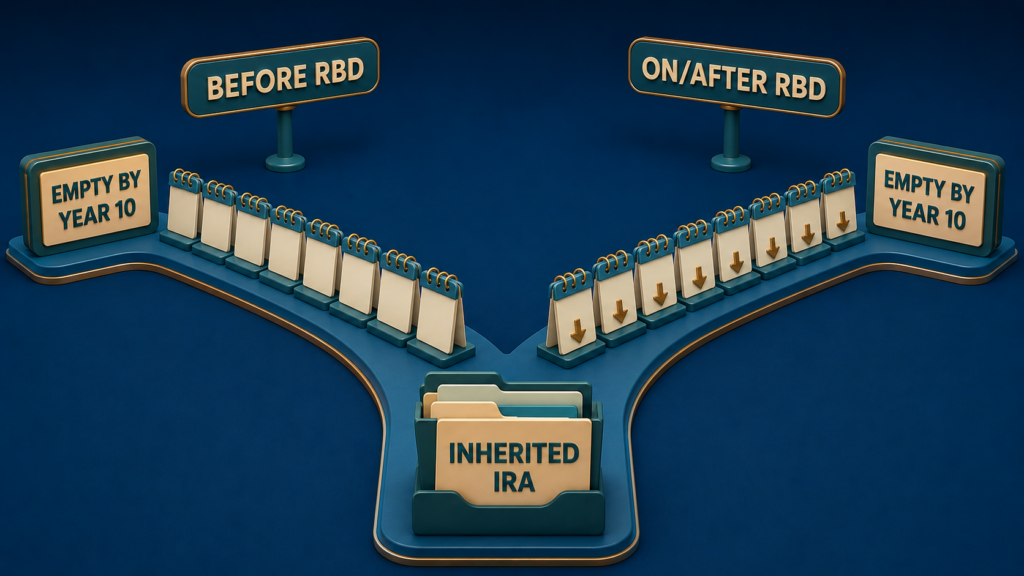
The RBD branch affects whether annual beneficiary RMDs may apply before the year-ten deadline.
Step 3: count the deadline correctly
The year of death is not year one. Under the 10-year rule, the account must be fully distributed by December 31 of the year containing the tenth anniversary of the owner’s death. [1]
| 2026 death example: If the owner dies in 2026 and the 10-year rule applies, year one is 2027 and the final deadline is December 31, 2036. The rule sets an outside date; it does not create one universal withdrawal pattern. [1] |
The same counting convention applies to the five-year rule: an owner who dies in 2026 can create a December 31, 2031 depletion deadline when that rule applies. [1]
Do not overlook the year-of-death RMD
If the owner died on or after the RBD and had not completed the RMD for the year of death, the beneficiaries are responsible for distributing the remaining amount. The calculation is made as though the owner lived for the full year. This is separate from the beneficiary schedule that begins after the year of death. [1]
| Correction relief: Final regulations provide an automatic waiver for certain missed year-of-death RMDs corrected within the specified period. The conditions and deadline should be checked before relying on relief; do not assume every late distribution is automatically excused. [3] |
Traditional and Roth inherited IRAs
Traditional IRA distributions are generally ordinary income to the extent they represent pre-tax money. A beneficiary distribution after death is generally exempt from the 10% additional tax for early distributions, even if the beneficiary is under age 59½. [1]
A surviving spouse who elects to treat the account as the spouse’s own changes the account’s status. A later withdrawal before age 59½ may then be subject to the usual 10% additional-tax rules unless another exception applies. That is one reason a younger surviving spouse may compare inherited status with an own-IRA election before moving the money. [1]
A Roth IRA owner has no lifetime RMD, so the owner is treated as dying before the RBD. Most adult non-spouse beneficiaries still face the 10-year deadline, but annual RMDs generally are not required in years one through nine. Distributions are often tax-free, but inherited Roth earnings can be taxable if the Roth qualification period has not been satisfied. [1,6]
Basis, withholding, and records

Traditional and Roth inherited IRAs can share a deadline while differing in tax treatment and recordkeeping.
If the decedent made nondeductible traditional IRA contributions, the basis remains with the inherited IRA. A nonspouse beneficiary must keep that basis separate from personal IRAs and IRAs inherited from other decedents. Form 8606 may be required to divide a distribution between taxable and nontaxable amounts. [1,6]
The current Form 8606 instructions specifically require filing for a distribution from an inherited traditional IRA with basis or from an inherited Roth IRA when the distribution is not qualified. Missing the decedent’s Forms 8606 can cause the beneficiary to overstate taxable income or lose the ability to substantiate basis. [6]
IRA distributions can be subject to federal withholding, and Form W-4R is used to elect the rate for nonperiodic IRA payments. A large distribution can also create an estimated-tax issue even when the custodian withholds some tax. [7]
Account title and plan terms matter
A nonspouse beneficiary cannot treat the inherited IRA as a personal IRA, contribute to it, or complete a normal 60-day rollover. A trustee-to-trustee transfer is permitted when the receiving IRA remains titled in the deceased owner’s name for the beneficiary’s benefit. [1]
Employer retirement plans can impose distribution procedures or choices that differ from the default IRA framework. Before moving or distributing plan assets, identify whether a direct transfer to a properly titled inherited IRA is available and whether the plan document limits the timing choices. [1,2]
Three common scenarios
Scenario 1 — adult child, owner before RBD. An adult daughter inherits a traditional IRA from a parent who died before the RBD. She is not an EDB. She generally has no annual RMD in years one through nine, but must empty the account by December 31 of year ten. [1]
Scenario 2 — adult child, owner after RBD. An adult son inherits from a parent who died after the RBD. He generally must take annual beneficiary RMDs and still fully distribute the account by the end of year ten. [1,3]
Scenario 3 — surviving spouse, age 55. A sole-beneficiary spouse may keep the account inherited or elect own-IRA treatment. Inherited status can preserve the death exception to the 10% early-distribution tax; own-IRA treatment may simplify long-term administration. The better fit depends on withdrawal needs, ages, RBD timing, and account terms. [1]
Why withdrawal timing deserves attention
When the beneficiary has flexibility, the choice is not limited to taking everything immediately or waiting until the last day. Partial distributions can spread taxable income across years; delay can preserve tax-deferred or tax-free growth. Annual RMDs, where applicable, are minimums rather than a complete tax strategy.
| Illustration—not an RMD calculation: With no investment change, distributing a $500,000 inherited traditional IRA as $50,000 per year concentrates less income in any one year than a single $500,000 year-ten withdrawal. Neither pattern is automatically better: account growth, tax brackets, cash needs, Medicare premiums, state tax, and mandatory annual RMDs can change the result. |
A practical inherited IRA checklist
- Identify the account type and whether the asset is an IRA or an employer plan. [1,2]
- Record the date of death and any five- or ten-year final deadline. [1]
- Determine whether the owner died before or on/after the RBD. [1]
- Confirm whether the owner completed the year-of-death RMD. [1]
- Classify every beneficiary and determine whether separate-account or trust rules apply. [1,2]
- Keep nonspouse assets properly titled and use trustee-to-trustee transfers when moving them. [1]
- Preserve Forms 8606, 5498, and 1099-R and any decedent basis records. [6]
- Calculate annual beneficiary RMDs using the correct table and account balance when required. [1,3]
- Review withholding or estimated-tax needs before a large distribution. [7]
- If an RMD was missed, correct it promptly and review Form 5329 relief procedures. [5]
Frequently asked questions
Can every beneficiary wait until year ten to withdraw anything?
No. When the owner died on or after the RBD, annual beneficiary RMDs generally apply to a non-EDB even though the account must also be empty by year ten. If the owner died before the RBD, no annual amount is generally required in years one through nine under the 10-year rule. [1,3]
Can a nonspouse beneficiary combine the account with a personal IRA?
Generally, no. The inherited account must retain inherited status. A direct trustee-to-trustee transfer may be possible, but the receiving account must remain properly titled. [1]
Does the 10% early-distribution tax apply?
Generally not to a distribution paid to a beneficiary after the owner’s death. Ordinary income tax may still apply, and a spouse who converts the account to an own IRA can face different early-distribution rules. [1]
Does the 10-year rule apply to an inherited Roth IRA?
For most adult nonspouse beneficiaries, yes. The account generally must be empty by year ten, while annual RMDs are generally not required in years one through nine because a Roth owner is treated as dying before the RBD. [1]
What is the penalty for a missed RMD?
The excise tax is generally 25% of the shortfall. It can be 10% when the shortfall is corrected within the statutory correction window and the required return is filed. The IRS may waive the tax for reasonable error when reasonable steps are taken to fix it. [5]
Final takeaway
The 10-year rule is a deadline framework, not a complete withdrawal instruction. The correct schedule depends on beneficiary category, the owner’s RBD, the account type, the year-of-death RMD, and the governing document. A written timeline plus preserved basis records can prevent the two costliest errors: missing an annual RMD when one applies and leaving money after the final depletion date.
Claim notes and fact-checking record
| Verification scope: The beneficiary matrix was cross-checked against IRS Publication 590-B and the final RMD regulations. The article deliberately identifies trust, plan-document, pre-2020, and successor-beneficiary cases as exceptions rather than forcing them into the general 10-year summary. |
| Marker | Primary-source support |
|---|---|
| [1] | IRS — Publication 590-B (2025), Distributions from IRAs — Primary IRS guidance for inherited IRA categories, 5- and 10-year rules, RBD branches, year-of-death RMDs, Roth treatment, basis, transfers, and the death exception to the 10% tax. |
| [2] | IRS — Retirement Topics: Beneficiary — Provides a beneficiary-oriented summary and highlights spouse, designated-beneficiary, and non-individual branches. |
| [3] | IRS — Final RMD regulations, Internal Revenue Bulletin 2024-33 — Final regulations governing annual distributions under the post-SECURE Act 10-year framework and specified correction relief. |
| [4] | IRS — RMD FAQs — Explains required beginning dates and current RMD administration. |
| [5] | IRS — Instructions for Form 5329 (2025) — Confirms the 25% excess-accumulation tax, 10% correction rate, correction window, and reasonable-cause waiver process. |
| [6] | IRS — Instructions for Form 8606 (2025) — Confirms reporting for inherited traditional IRAs with basis and inherited Roth distributions that are not qualified. |
| [7] | IRS — Form W-4R — Explains federal withholding elections for nonperiodic IRA and retirement-plan payments. |
| Educational use only: This article provides general educational information, not individualized tax, legal, Social Security, or investment advice. Rules, forms, agency interpretations, and individual outcomes can change. Use the official materials for the applicable year and facts. |